Tuesday, April 25, 2006

laila lalami's novel

0 comments


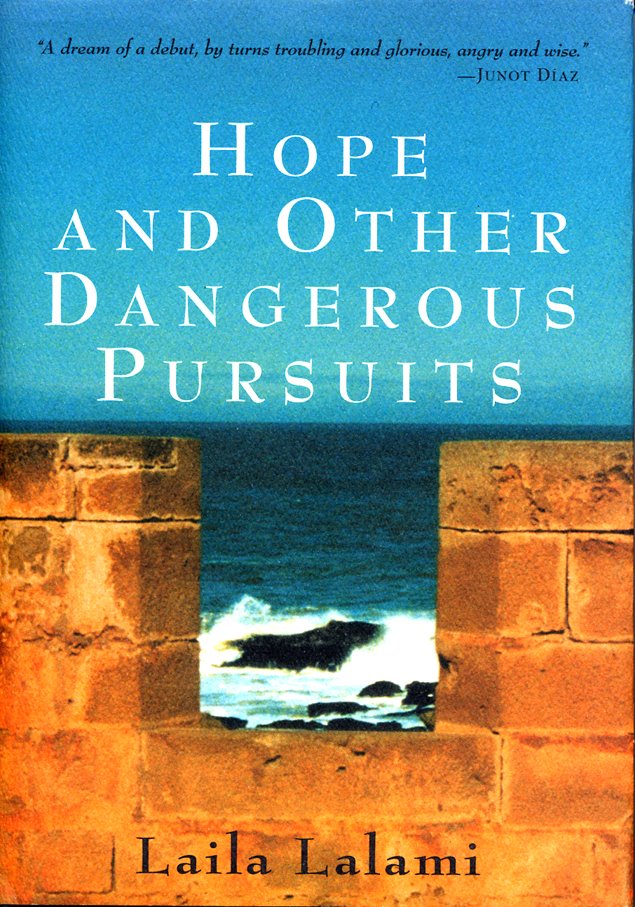
The Moroccan writer Laila Lalami wears more than one hat. She is known to internet users worldwide for her stylishly-presented and incisive literary blog “Moorish Girl”. And she is also a novelist writing in English, with her first novel “Hope and Other Dangerous Pursuits” published in the US by Algonquin Books of Chapel Hill, North Carolina.

Born in Rabat, and educated in Britain and the US, Lalami lives in Portland, Oregon. She brings to her novel the same qualities of clarity, liveliness and insight that characterise “Moorish Girl.”

In the novel’s introduction, seen through the eyes of graduate Murad, we are introduced to a group of characters crossing illegally to Spain at night in a flimsy boat. “Fourteen kilometres. Murad has pondered that number hundreds of times in the last year trying to decide whether the risk was worth it.”

The characters include a young women Faten who wears a hijab, Aziz who is on a second attempt to cross the Strait of Gibraltar, and abused wife Halima running away with her children. As the boat nears the Spanish coast, the migrants are ordered to swim to land, although not all can swim.

The next section of the book, “Before”, explores the reasons for the characters’ decision to take this risky voyage. The final section “After” looks at what becomes of the characters..

Lalami does not take the obvious path in approaching her characters. We first see Faten from the point of view of a father working at the Ministry of Education worried about the influence of this religious girl on his daughter. He uses his position in the educational bureaucracy to exact a revenge that will blight Faten’s future.

Lalami writes an uncluttered prose with grace and fluency. Her novel is relatively brief at 195 pages, but every word counts. Her deft and subtle characterisation has much humanity, and also irony and playfulness as in her depiction of Murad and his efforts to be a guide in Tangier, an over-crowded field. His opening line to tourists is: “Interested in Paul Bowles?”

Are those who do manage to make it to Spain really better off than those who are turned back and returned to Morocco? The migrants’ dreams are inevitably tempered by reality. Aziz and his wife pay a high price for their years of separation, and on his first visit home his memories of the women he consoled himself with while away somehow sully his relations with his wife.

Faten attains an independence in Spain, but only through selling her body. The Orientalist attitudes of some European men are alluded to in her odd relationship with young Spanish client Martin. As for Murad, he may find his way not by leaving Morocco, but through following his gift for storytelling.

Lalami’s novel is a major contribution to the literature on migration and on the ambiguous relationship between the two sides of the Mediterranean, and thus between two cultures. These contemporary themes will become all the more pressing in the future.

Susannah Tarbush, Saudi Gazette April 25 2006

Tuesday, April 18, 2006

booklet on bethlehem

0 comments
Widad Kamel Kawar is famed for the extensive collection of Palestinian and Jordanian traditional costumes, weavings, jewellery, amulets and everyday tools she has built up over 45 years. As well as being a means of salvaging and preserving Palestinian culture, the collection is a vital resource for researchers and museums.

Now Mrs Kawar, who lives in Amman, has written a booklet entitled "Bethlehem: From Golden Threads to Cement Blocks." The Golden Threads are the threads used in the exceptionally rich embroidery of Palestinian dresses in Bethlehem, which were traditionally imported from Syria. The Cement Blocks are the hideous grey ramparts of the apartheid wall that is making daily life in Bethlehem so difficult. Mayor Dr Victor Batarseh describes the town as an "open air prison".

Mrs Kawar writes that her booklet contrasts Bethlehem's glorious art form of textiles and embroidery "which reflects an innovative and refined society, with the current Israeli actions and policies to isolate, impoverish and dispossess its people."

The wall isolates Bethlehem from Jerusalem, less than six kilometres away. Economic life is declining, and Bethlehem has deteriorated from a flourishing centre for pilgrimages and tourism into an isolated enclave.

The attractively-designed booklet juxtaposes black and white historical photographs of Bethlehem and its people with examples of colourful embroidery and costumes. It also highlights the architecture of the town including the castles (qasoor), built by prominent families, some of which now lie outside the apartheid wall.

The pinnacle of the costume industry is the malak (royal) dress, so called because of its richness. In addition to the brightly striped and embroidered dress, the malak ensemble includes a short-sleeved embroidered jacket known as the takseereh, a high fez-like shtaweh headdress adorned with the gold coins of the dowry, and a silk shawl. The headdress is fastened under the neck with the silver Chain of Seven Souls. The costumes reflected the wealth of the town.

The booklet, designed by Salua Qidan of the Jordanian design and digital solutions company SYNTAX, is a most valuable and informative publication, and it is to be hoped it will be widely distributed. In depicting the fate of Bethlehem and its culture, it powerfully portrays the conditions that the Palestinians have had to endure more widely.

The Kawar collection is at www.arabheritage.org

Susannah Tarbush
Saudi Gazette April 18 2006

sotheby's sells archive of makkah and medina photos

0 comments


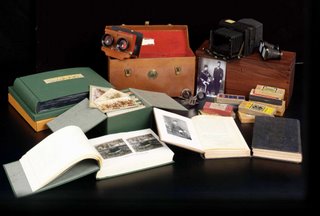
An archive of photographs of Makkah and Medina dating from the early 20th century has been on display at Sotheby’s auction house in London in preparation for the Natural History, Travel, Atlases and Maps sale on May 9. The sale of the archive is expected to realise £40,000 to £60,000.

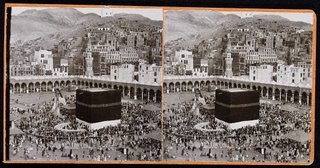
The photographs were taken by Muhammad ‘Ali Effendi Sa’oudi (1865-1955) who accompanied General Ibrahim Rif’at Pasha on two pilgrimages from Egypt to Makkah and Medina in 1904 and 1908. The general was responsible for protecting the mahmal procession which carried to Makkah the elaborate embroidered draperies known as the kiswa for the covering of the Ka’ba.

Sa’oudi worked for the Ministry of Justice in Cairo where he specialised in identifying forged documents. His Dresden Stereo Palmos camera, on of the most advances cameras of its day, is included in the sale along with a wooden stereoscope for viewing its slides. The stereoscopic slides appear as 3D images when viewed through the stereoscope.

There are 114 original photographs, 88 stereoscopic glass slides and a modern album containing a complete set of prints of the slides. There are also 80 stereoscopic photographs mounted on card.

There are images of Al Haram Mosque in Makkah, including internal shots with the Ka’ba and Zam Zam, and of the Prophet’s Mosqueon Medina. Other images show archaeological sites and intimate photographs of groups and individuals.

Although Sa’oudi’s photographs are of great interest, they are not the earliest photographs of the two holy cities. Muhammad Sadiq Bey, an Egyptian colonel and engineer photographed Medina in 1861 and Makkah in 1880. Sotheby’s sold his original photographs of Makkah in 1998 for a world record of £1.25 million.

General Rif’at Pasha wrote a lavishly-illustrated book, “Mir’at Al Haramayn Aw Al Rihlat Al Hijaziyya”, published in Cairo in 1925, on his four journeys to Makkah and Medina between 1901 and 1908. Many of the 557 photographs in the book were taken by Sa’oudi. The sale includes Sa’oudi’s copy of the first edition of the book.

Sa’oudi’s contribution to the book, as well as his literary skill and literary output, have not previously been fully recognised. Sotheby’s says that through the archive he “emerges from the shadows as a man who brought the natural and architectural splendour of the future Saudi Arabia to a wider audience just as the Kingdom was reaching pre-eminence.”

The sale includes two manuscripts written in Arabic in Sa’oudi’s hand. “A Synopsis of the Pilgrimage” was written after his first pilgrimage, and “The Construction of the Ka’ba” was written after 1905.

There is also Sa’oudi’s “Voyages au Hedjaz et en Arabie” (1919) with printed text in Arabic and French and manuscript annotations by the author, together with a modern English translation. And there is an unpublished translation into Arabic of the chapters on Makkah and Medina from J L Burckhardt’s “Travels in Arabia” published in 1829.


Susannah Tarbush
Saudi Gazette April 18 2006

Tuesday, March 28, 2006

banipal literary evening in london

0 comments

Hisham Mattar Posted by Picasa


Londoners wanting a taste of the literature being written by Arabs living in exile had their chance last Wednesday night when three London-based writers - Ghalya al-Said from Oman, the Libyan Hisham Matar and Ghalia Kabbani of Syria - presented their work at the Irish Centre in Hammersmith, West London.

They also had the chance to taste Arabic food from an enticing buffet of dishes such as ful, homous, kibbe and tabboule freshly prepared by the Iraqi novelist Samuel Shimon (author of "An Iraqi in Paris").

Shimon is co-founder of Banipal, the London-based magazine of modern Arab literature, which presented the evening. The event was part of the Westwords Live literature festival being held in West London by eight boroughs during March and April. It was introduced by Banipal's Publisher and Editor Margaret Obank, and chaired by Christina Phillips, an Arabic scholar who sometimes translates for Banipal.

Ghalya al-Said read in Arabic from her recently-published first novel "Days of Heaven". Obank, who read the English translation, described "Days of Heaven" as a novel that is set in London in the 1970s among the immigrant community. "The hero, Ghassan, is a fantasist Don Juan who left his homeland to come to try and find his fortune as a major con man and desperado, and all the adventures he has are recounted." Al-Said writes with acute observation and humour. Ghassan finds that London, unlike cities elsewhere, helps him to keep his many secrets.

Hisham Matar read from his first novel "In The Country of Men". The book trade regards this novel as one of the hottest books due to be published this summer. It was sold in auctions in Europe and the US within a week of being submitted to publishers. It will be published in July by Viking, an imprint of Penguin, and then in 13 other languages. A translation into Arabic is also under way.

Matar's sensuous, dreamy yet precise prose captures the atmosphere of Tripoli in the relentlessly scorching summer of 1979 as seen through the eyes of the nine-year old narrator. The sensitive boy's relationship with his troubled mother, and the mystery over his absent father glimpsed in the street, make a compelling start to the novel.

Christina Phillips read Ghalia Kabbani's story "A Cup of Tea With Mrs Robinson", translated into English by Ali Azeriah. The narrator of this thought-provoking story is a political refugee who describes returning home after a woman has assaulted her in the street injuring her face.

The husband's reaction to his wife's trauma falls far short of what she had hoped for. He is more concerned with discussing politics with his friends than with her welfare. With skill Kabbani takes us inside the realities of life for political refugees, and reveals the stresses political exile places on marriages. It is the English baby-sitter, formerly dismissed as a Mrs Thatcher type with her hairdo and her determination, who gives the narrator the spontaneous comfort she needs.

Susannah Tarbush
Saudi Gazette March 28 2006

Tuesday, March 21, 2006

from bangla-beat to afro-beat

0 comments

Idris Rahman

“From Bangla-Beat to Afro Beat” was the title of a concert held at the Queen Elizabeth Hall in London’s South bank Centre last Monday week to celebrate the musical heritage of Bangladesh. The concert was presented by Asia House, and the programme contained a message from the Bangladesh High Commissioner to the UK, Sabihuddin Ahmed, saying he hoped it would achieve its aim of “placing Bangladeshi music on the roster of mainstream performances in the UK.”

Runi Khan, who had the initial idea for the concert, said in her message in the programme that Bangladeshis, who comprise a significant portion of Britain’s Asian population, “are still best known for their curry houses and their rich musical heritage has had little sustainable exposure.” She hoped the concert would start to redress this situation.

The evening got off to an inspiring start with a pre-concert jazz recital, in the Queen Elizabeth Hall foyer, by the gifted jazz pianist Zoe Rahman and her clarinettist brother Idris who are of mixed Bangladeshi-English parentage. They gave wonderfully expressive and engaging performances in which they were accompanied by the lively Brazilian percussionist Anselmo Netto.

Award-winning Zoe’s second album, “Melting Pot” was released recently. Soothsayers, the band Idris leads, released its album “Tangled Roots” a few months ago. As a prelude to the “Bangla-Beat” concert, the recital included some Bengali material based on four songs by the singer and composer Hemant Mukherjee.

The “Bangla-Beat” concert was designed to cover a wide range of music, from traditional folk music and the music of the new generation in Bangladesh to collaborations between Bangladeshi, Asian and world musicians.

The first half of the concert featured Baul culture, declared last November by UNESCO as a national treasure. The Bauls are a mystical group of wandering faqirs who perform devotional songs accompanied by traditional string and percussive instruments.

The Baul performers were Abdur Rob Fakir and Shahjahan Munshi. Also on stage were members of the Ektaar All Stars. The young singer-songwriter Shayan Choudhury, known as Arnob, who is also an instrumentalist, composer, painter and music video maker, sang an appealing selection of songs. His debut solo album “Chaina Bhabish” was released last year.

The Ektaar line up also included Ektaar’s managing director Faisal Siddiqi (Bogey), as bass player and vocalist. He is the guitarist and vocalist of Renaissance, one of Bangladesh’s most established bands. On lead guitar was Al Fahmi Kazi Bashar, known as Kaartik, who plays lead guitar for the group Bangla. On vocals and percussion was Sahana Bajpaie, whose first solo album of songs by Tagore is due out soon.

The second half of the concert was given over to Bangladesh-born Kishon Khan, who grew up in London, and his new world fusion assembly of musicians called Lokkhi Terra. Khan played the piano and Rhodes electric piano. His line-up included more than a dozen performers, among them special guest Fazal Qureshi (second son of the late Ustadh Allarakha) on tabla, Pandit Dinesh on Indian percussion, and the young Pakistani flautist Haider Rahman. Other instruments included trombone, trumpet, cello, bass, guitar, drums and congas. Lokkhi Terra included two singers from Bangladesh, Armeen Musa and Aneire Khan.

Susannah Tarbush
Saudi Gazette March 21 2006
0 comments

Zoe Rahman in recital

Tuesday, March 14, 2006

British Council's Arabic translation seminar

0 comments
The four-day Arabic/English literature translation seminar organised in London last week by the British Council, in partnership with Arts Council England, was one of the most ambitious and wide-ranging explorations of the subject ever to have been held.

The seminar brought together leading Arab, British and other writers, translators, commissioning editors, literary agents, publishers and academics. The sessions on a variety of topics were supplemented by one-on-one interviews with two major Arab women writers, the Lebanese Hanan Al-Shaykh and the Moroccan Leila Abouzeid.

The seminar provided ample evidence of how rich and diverse the field of translating and publishing Arab writers has become in the past few years. One of the valuable spin-offs was the opportunity afforded for networking and contact building.

The event began on Tuesday at the London Book Fair, where a panel examined the translation of Arabic into English and vice versa, and the strengthening of links between the UK and Arab world in publishing, distribution, translation and cultural exchange.

The panel was chaired by translator, author and former British Council representative Peter Clark. It included Jordanian author Fadia Faqir, Palestinian poet and author Mourid Barghouti, Palestinian poet and novelist Ibrahim Nasrallah, and Margaret Obank, the publisher and editor of Banipal magazine of modern Arab literature.

On the following two days, the venue of the seminar was Goodenough College. There were several ‘guest hosts’ for specific sessions, among them Banipal, the British Centre for Literary Translation (of the University of East Anglia), the Poetry Translation Centre of London University’s School of Oriental and African Studies, and English PEN.

On Thursday evening there was a reception and dinner for seminar participants at the October Gallery in Bloomsbury, followed by author readings and a party. The final event was a brainstorming roundtable on Friday morning to discuss future plans and opportunities to increase links between UK literature professionals and Arab partners.

The Saudi novelist and short story writer Yousef Al-Mohaimeed, who is cultural editor of Al-Yamama magazine, was a speaker at a session on Thursday entitled: ‘How to create and maintain a dialogue: writers making connections.’ Born in Riyadh in 1964, Al-Mohaimeed is one of the new generation of Saudi fiction writers whose work tackles head-on the social conditions of the country.

Two chapters of Al-Mohaimeed’s novel “Traps of Scent”, translated by Anthony Calderbank, were published in Banipal’s special feature on the Saudi novel in its Summer 2004 issue.

“Traps of Scent” was originally published in Arabic by Riad El-Rayyes in Beirut in 2003; Al-Mohaimeed pointed out that because of censorship, a number of Saudi novelists have had their work published in Beirut. He expressed frustration at the misleading images of Saudi Arabia in the West, first as a country of camels, tents and oil and then, after 9/11, as a country of terrorism.

Al-Mohaimeed spoke of some of the difficulties facing Saudi novelists, and artists in such areas as film, theatre and the visual arts, but noted signs of an increased openness. He would clearly like British publishers to take an interest in Saudi novelists, but rejected pressure on those writers to write in a certain way. “In writing novels we feel that we are part of the world – we know the techniques of the novel and we want to contribute, but we don’t want to be ‘folkloric’.”
Susannah Tarbush
Saudi Gazette, 14 March 2006
Saudi novelist Yousef Al-Mohaimeed (L) and Syrian writer Fawaz Al-Haddad
 
ban nha mat pho ha noi bán nhà mặt phố hà nội