Thursday, December 14, 2006

libyan female graphic novel writer interviewed

0 comments

On Woman's Hour today, presenter Jenni Murray interviewed a young Libyan woman now living in Scotland, Asia Alfasi, who is author of a two-part autobiographical graphic novel to be published by Harry Potter publisher Bloomsbury. The item is Woman's Hour podcast of the day. Jenni seemed obsessed by the fact that the artist wears a headscarf, and rather a lot of her questioning was about this rather than about the work. Asia was an engaging, fast-talking interviewee, and explained how her work is influenced by manga, the Japanese comic book tradition.

Asia isn't the only Middle Eastern woman to have opted for the graphic novel form. The Iranian Marjan Satrapi is author sof the acclaimed cartoon strip books Persepolis , Persepolis 2 and Poulet au Prunes. Persepolis is being made into a French-language film featuring the voices of Catherine Deneuve and her daughter Chiara Mastroianni among others.

From the Woman's Hour website:

"Cartoons and comic strips have always been politically emotive - the global backlash against cartoons of Muslims published in Denmark earlier this year proved the power of the medium. But the latest sensation to hit the publishing world is a young Muslim woman who says her cartoons are aimed at reconciling cultures and promoting understanding between Islam and the West.

"Asia Alfasi was born in Libya and moved to Scotland with her family at the age of 8. Now aged 22, she’s just signed a deal with Bloomsbury to publish her 2 volume autobiography in the form of a graphic novel. The first volume will be about her life in Libya, the second volume is set in Scotland. Her work draws on themes of family, faith and culture and the central character is a young girl who wears the headscarf. She joins Jenni in the studio. "

Friday, December 8, 2006

freemuse's 3rd world conference held in Istanbul

0 comments

Freemuse’s 3rd World Conference on Music and Censorship
by
Susannah Tarbush

It was particularly appropriate that the Danish organisation Freemuse, which campaigns for freedom of musical expression, chose Istanbul as the venue for its recent 3rd World Conference on Music and Censorship. Istanbul has one of the most exciting and diverse music scenes of any city in the world today, as shown by the acclaimed 1995 documentary film “Crossing the Bridge: The Sound of Istanbul” directed by Fatih Akin.

But at the same time numerous Turkish musicians, and others involved in the music industry, have over several decades suffered censorship, restrictions, and in some cases arrest, imprisonment and exile.

The two-day conference was held at Bilgi University. Professor Turgut Tarhani, dean of the faculty of law and director of the university’s Human Rights Law Research Centre, described the conference as “one of the important events on the Turkish social and human rights scene in recent years and the months or the years to come.”

On the second day of the conference a new Turkish initiative was launched named ‘Sanatta Sansure Son (SSS)’, meaning ‘End to Censorship in the Arts’. Marie Korpe, the executive director of Freemuse, said in her speech: “The new initiative started among young musicians, but is not limited to music, because other branches of the arts also need such an initiative.” Korpe noted that Turkey is now the only country of the 22 countries represented at the conference to have a specific organisation defending the right of musicians and artists to free expression.

The session on Turkey was one of the most moving parts of the conference. It was presented by the composer and song writer Sanar Yurdatapan, spokesman of the ‘Association for Freedom of Expression’. Yurdatapan has been imprisoned three times and continuously harassed, and for some years he was exiled in Germany and stripped of his Turkish citizenship.

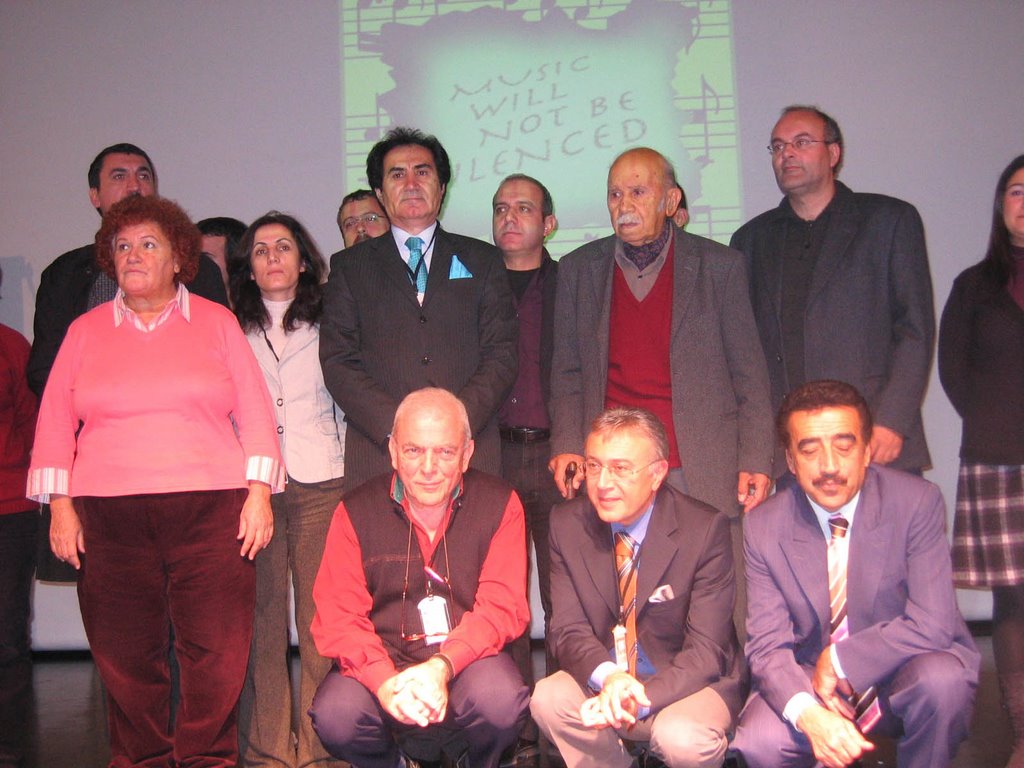
During the session some 15 Turkish singers, musicians, composers, broadcasters and music producers ascended to the platform one by one to give their personal testimony (above). They included the Kurdish singer Selda Bagcan who was known in the 1970s as ‘the Turkish Joan Baez’. She was arrested, tried and imprisoned after the 1980 coup and as recently as May this year was prevented by the authorities at Ataturk airport, Istanbul, from travelling to Canada for a concert.

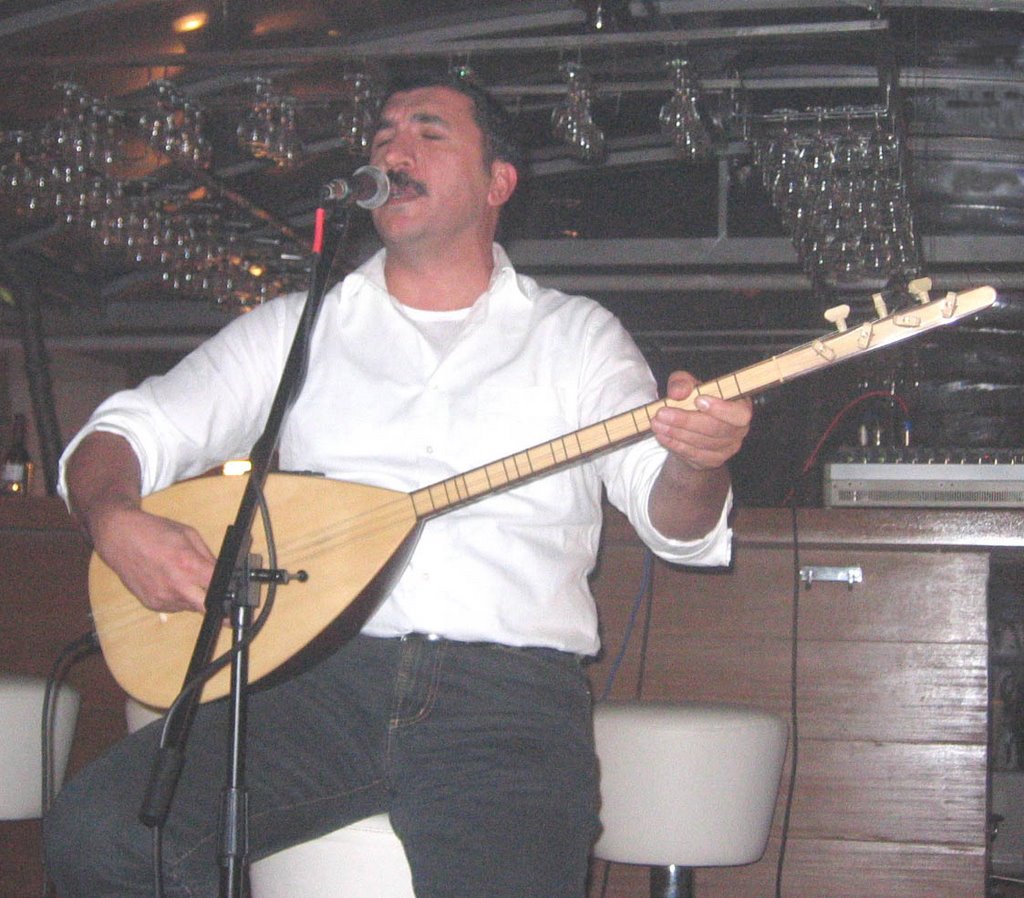
Another Kurdish singer, Ferhat Tunc (below left), has been banned and imprisoned several times and is still facing court action. Members of the band Grup Yorum, known for its political songs, have been put on trial and imprisoned many times.

Gulten Kayat, widow of the Kurdish poet, singer and artist Ahmet Kaya told of how he went into exile in France in 1999 after announcing at a concert that his next album would be in Kurdish. In March 2000 he was sentenced in absentia to a prison term. He died of a heart attack in Paris in that year and Gulten told the conference: “The only reason he died at the age of 43 was that he was exiled.”

Selda Yesiltepe, editor of the Voice of Anatolia radio station, which is described as “the voice of the oppressed”, spoke of the pressures on the station from the Radio and Television Higher Board. For example the station was closed for three months in 2001 for broadcasting a programme on hunger strikers in prison and in 2003 it was closed for a month for broadcasting a song by Ahmet Kaya.

From an earlier generation, the 87-year-old writer Vedat Turkali told of the five years he spent in prison with the late singer and musician Ruhi Su in the 1950s. Turkali said: “He suffered a lot; they took away his musical instruments.”

The conference was attended by more than 200 musicians, composers, and scholars from 22 countries. It focused on music censorship in countries ranging from Cuba, Zimbabwe and South Africa to Indonesia, China and Afghanistan. In addition, there were sessions on North Africa and the Middle East, and on West Africa.

The conference was also the occasion for the launch of Freemuse’s latest special report, on Belarus. The authors of the report, Lemez Lovas and Maya Medich, found that the regime of President Lukashenko has a “fear of music as potential fuel for revolution and unrest, as in the Ukraine in 2004.” This has led to “restrictive broadcasting legislation and the reinvigoration of a huge bureaucratic system of censorship that is pushing independent musicians back into the role of Soviet era dissidents.”

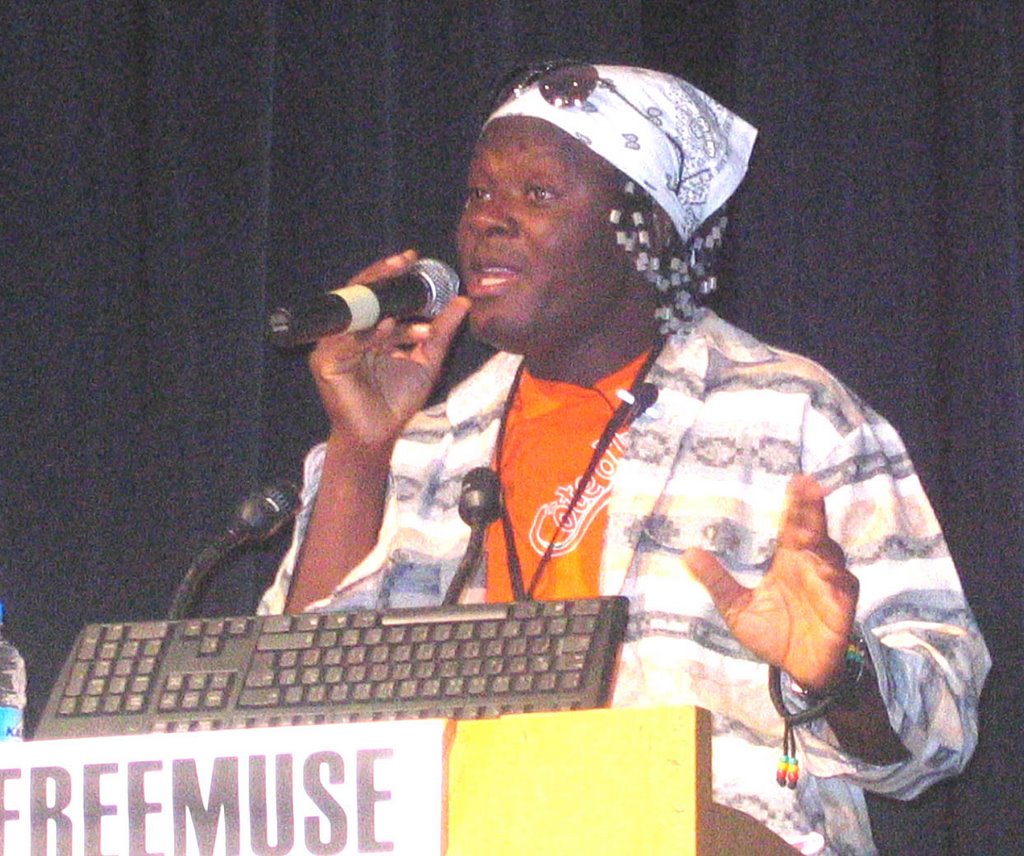
The conference was opened by wonderful unaccompanied singing from the Iranian singer Mahsa Vahdat and her sister Marjan (below, right). Several of the speakers included live musical performances as part of their presentations. The Ivory Coast reggae star Fadal Dey (below right) walked onto the conference platform singing in French, and later performed his new song “Free Iraq”.

As the studies from different countries showed, music censorship is a complex subject. It is for reasons including politics, religion, sexuality, ethnicity or history. It takes various forms, including government legislation and other measures, social pressures and the policies of broadcasters and the recording industry. Added to this is the pervasive and damaging phenomenon of self-censorship.

The Zimbabwean government of Robert Mugabe has adopted a particularly tough and blatant approach towards music censorship. The Zimbabwean journalist Maxwell Sibanda explained: “In 2001 the government decided to record music itself. It put aside some money and said it was going to record music to promote its policies.”

The then information minister Jonathan Moyo coordinated and recorded four music albums, and a fellow minister recorded two music albums and sang on some of the songs that appeared on videos. In all, the government recorded more than 10 music albums. It banned all foreign music from radio, and foreign films from television, and blacklisted all musicians singing against its policies. As the government owns Zimbabwe’s one TV station and all four radio stations, one song produced by the government might be broadcast 72 times in one day, Sibanda said.

The Zimbabwean singer Thomas Mapfumo moved with his family to live in the US for safety reasons after criticising the government in his songs. Musicians from other countries have also been forced into exile. The exiled Uyghur composer, musician and poet Kurash Sultan from East Turkistan (the Xinjiang province of China), who took refuge in Sweden in 1999, had been due to speak at the conference but he suddenly died of a heart attack on 29 October at the age of only 47.

Sultan was imprisoned and tortured by the Chinese authorities and many of his songs, which called for freedom, were banned in East Turkistan. The China session of the conference was dedicated to his memory, and his brother Kaiser Abdurusul travelled from Sweden to give an emotional address about him and to play a video of his virtuoso playing of the stringed lute known as the duttar.

Jeroen de Kloet of the University of Amsterdam noted that in China censorship has loosened tremendously over the past 10 years. For example since 1997 there has been the annual three-day Midi rock festival in Beijing. “China doesn’t really exist – there are many Chinas,” De Kloet said. Thus a musician not allowed to perform in Beijing may be allowed to perform in South China.

But De Kloet referred the complicity of the West in Chinese censorship, with Google for example agreeing to censor sensitive material on its China service.

The session on South Africa was remarkable in that it brought together on the same platform the white musician Roger Lucey and the former secret policeman Paul Erasmus who in the 1980s successfully destroyed Lucey’s musical career as a political folk singer performing songs against apartheid. In 1995 Erasmus went public and admitted what he had done, and in 2001 he was granted amnesty by the Truth and Reconciliation Commission for his activities against Lucey.

Alongside Lucey and Erasmus on the platform were Freemuse’s Programme Officer Ole Reitov and Michael Drewett of Rhodes University, South Africa. Reitov prompted Freemuse to fund an extraordinary film entitled “Stopping the Music: a story of censorship in apartheid South Africa” which tells the story of Lucey and Erasmus, and in which the two men meet for the first time. Drewett researched, co-wrote and produced the film.

In Indonesia the musician Ahmad Dhani, a founder in 1986 of the highly popular rock group Dewa 19, has been challenging religious extremism through his recent music. Andrew Fuller of the University of Tasmania, Australia, explained that Dhani is opposed to the violent ideology of groups such as Front Pembela Islam (FBI) meaning ‘The Front for Defenders of Islam’ - and ‘Laskar Jihad’ (Soliders of Jihad).

In November 2004 Dewa 19 released the CD ‘Laskar Cinta’ meaning ‘Soldiers of Love’. In February this year it released the CD ‘Republik Cinta’ or ‘Republic of Love’. “What Dewa and Ahmed Dhani are doing is using their music to confront the conservatism of a large portion of Indonesian society,” Fuller said.

In addition to the examples of music censorship given during the conference, musicians have been facing increasing problems in getting visas and travelling since the terror attacks in the US on September 11 2001. Freemuse’s executive director Marie Korpe said that the tightening in visa procedures is “a threat to musicians” and is hitting musicians travelling from developing countries, as was seen at Freemuse’s 2nd world conference in Copenhagen in 2002 and now at the Istanbul conference. For example Fadal Dey, the singer from the Ivory Coast, had to travel to Senegal and wait a week for his Turkish visa. And Mario Masvidal, the speaker from Cuba, had to deal with Cuban, Turkish and finally French and Schengen bureaucracy.

Korpe said: “What lies ahead is difficult to say but the question is whether in the future it will be possible to gather people from across the world at a conference like ours today.”

Original of article published in Arabic translation in Al- Hayat newspaper on December 8 2006


Tuesday, November 21, 2006

michael horovitz and moazzam begg poetry reading

0 comments
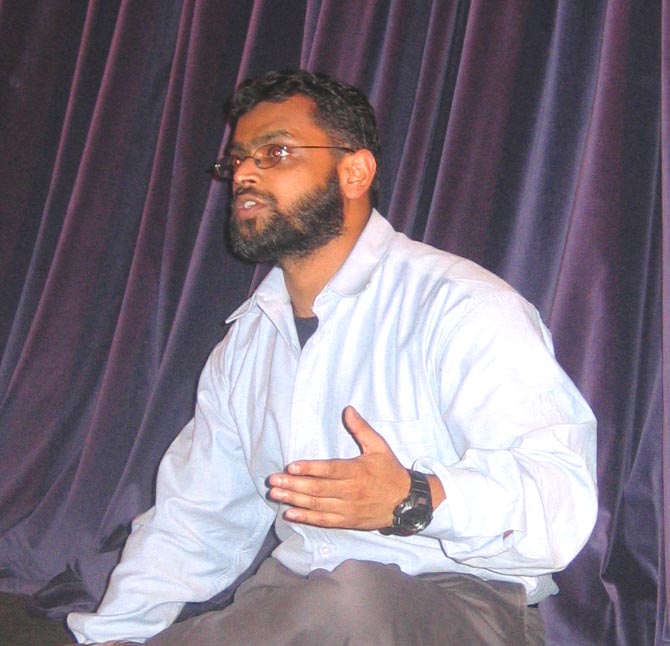
The veteran poet and poetry event organizer Michael Horovitz and former Guantanamo Bay detainee Moazzam Begg (left) might seem an unlikely pairing. But their joint poetry reading last Thursday evening at the Everyman Cinema Club in Hampstead, North London, revealed much common ground.

The reading was organized by Penned in the Margins, founded in 2004 by the young poet Tom Chivers to celebrate the power of words in performance and on the printed page. Chivers said the event would explore questions such as: “Can a poet be political? Can he or she engage with and respond to war and conflict? Should poets take sides, and what happens when poetry arises in the most unusual situations and settings?”

Begg’s poetry grew out of some of the most challenging situations imaginable. In February 2002 he was seized by the CIA in Islamabad and spent a year incarcerated in Bagram air base, and then two years in Guantanamo. It was only in January 2005 that he was released without charge. He witnessed the brutal treatment of fellow detainees, including two killings in Bagram.

“I’d never written poetry until Guantanamo Bay, and I’ve never written poetry after it,” Begg told the audience. The poems were written in solitary confinement, “where I spent two years in a cell measuring eight feet by six feet.”

Although Begg has written no poetry since his return to Britain, poetry was the catalyst for his continuing urge to express himself through words. His memoir “Enemy Combatant”, written in collaboration with journalist Victoria Brittain, was published a few months ago. Saudi publisher Al Obeikan is to publish it in Arabic translation. Begg frequently contributes op-eds to US and British newspapers, and he works for the Cage Prisoner Islamic human rights website at http://www.cageprisoner.com/

Begg found a strange beauty in the most ghastly surroundings. His poem “Chime of the Razor Wire” was inspired by the sound of intertwined barbed wire and razor wire rubbing against each other. “It sounds not unlike wind chimes, and it sounds almost calming, particularly when it’s pushed by a soft Caribbean breeze and particularly at sunset.”

Michael Horovitz has been a leading light in British poetry, and the organizer of major poetry ‘happenings’, for more than half a century. A man of many parts - troubadour, beat poet, songwriter-singer, visual artist - the Open Democracy website describes him as “a one-man poetic antidote to social complacencies”.

Numerous volumes of his poetry have been published, and he is also the editor of several important anthologies, some arising from events he has organized. During the poetry evening he read from some of his earlier work, and from his hugely ambitious new epic poem “A New Waste Land: Timeship Earth at Nillenium”.

This work, which took nine years to write, runs to 250 pages, including illustrations and cartoons, plus 150 pages of notes. Imbued with Horovitz’s characteristic wit, it is his take on New Labour and on national and international events.

Susannah Tarbush

Tuesday, November 14, 2006

national novel writing month

0 comments
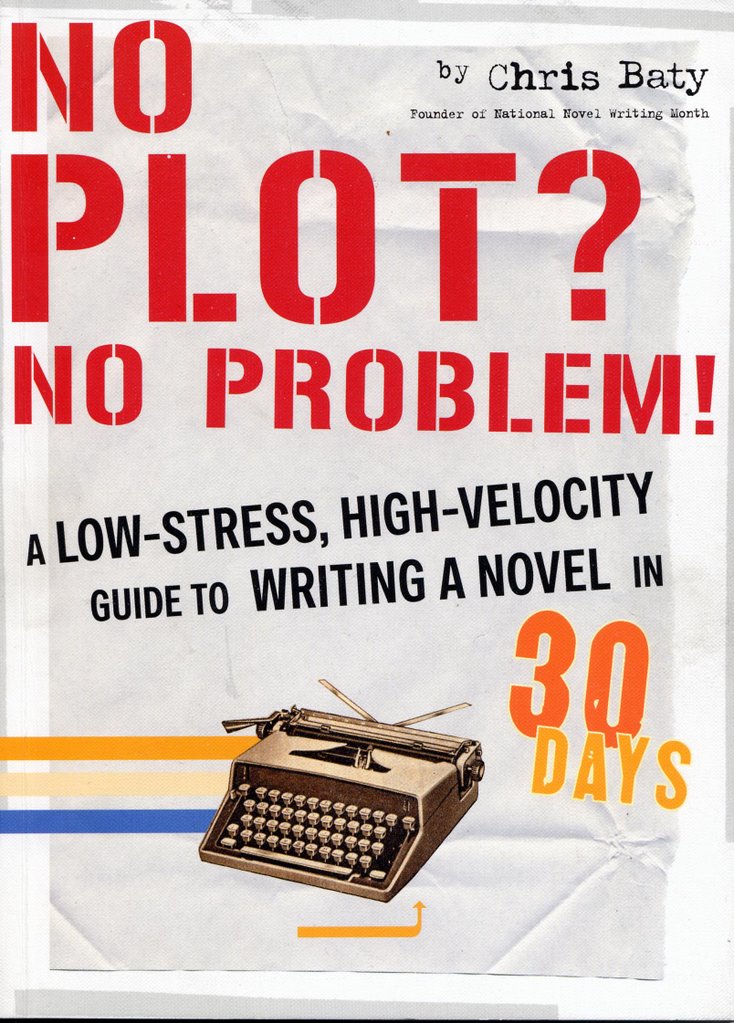
This November more than 77,000 people around the world have risen to the challenge of trying to write a novel of 50,000 words in the space of one month. National Novel Writing Month (NaNoWriMo) goes back to 1999 when a young writer named Chris Baty, living in the San Francisco Bay area of California, decided that he wanted to write a novel in a month.

Baty recalls: “In a more grounded age, my novel-in-a-month concept would have been reality-checked right out of existence. Instead, the very first National Novel Writing Month set sail two weeks later, with almost everyone I knew in the Bay Area on board.”

The 21 people who took part were “undertalented goofballs who had no business flailing around at the serous endeavor of novel writing.” They hadn’t taken creative writing courses or read how-to books on story or craft. “We were in our mid-twenties and we had no idea what we were doing. But we knew we loved books, and so we set out to write them.”

That first year, only six of 21 participants made it across the 50,000 word finishing line. Baty has organized NaNoWriMo every year since. The number of participants has grown rapidly, and this year 77,320 contestants are registered on the website at www.nanowrimo.org.

Participants submit their word counts to the website either through figures they provide, or through an online word counter. Although entire novels in progress cannot be posted on the site, participants can post excerpts. There are no prizes, but all who manage to produce 50,000 words are termed winners. By last Sunday, the participants had written more than 371.6 million words.

Baty’s breezy approach to fiction writing is reflected in the title of his handbook “No Plot? No Problem! Low-Stress, High-Velocity Guide to Writing a Novel in 30 Days.”
He urges writers to turn off their internal censors, and to regard the month’s output of 50,000 words as a rough first draft. And Baty claims that “plot happens”. He writes: “You don’t need to do research; you don’t need to understand anything about characters or plan out your setting. It’s fine to just start. And making it up as you go along does not require you to be a particularly gifted novelist.”

The website has six registered participants in Saudi Arabia. But only one, a 50-year-old man based in Riyadh, author of a work in progress entitled “As I Remember It”, had posted any word count to the website by last Sunday. His engaging excerpt is in the form of a memoir beginning with the narrator’s birth.

The other Saudi-based writers including 26-year-old Moody Writer with the novel “The Quest of Life”, 15-year-old alludra with “The Boat Maker”, and 60-year-old Dhahran resident jonikxx with “The Great Chunnel Heist” have yet to make their presence felt on the website.

NaNoWriMo may be no guarantor of good-quality writing, but tens of thousands of people worldwide find it a rewarding experience annually and many of this year’s participants are repeat performers from previous years And a few lucky participants have succeeded in having their NaNoWriMo novels published.

Susannah Tarbush, Saudi Gazette November 14 2006

Wednesday, November 8, 2006

saqi's 'sexuality in the arab world'

0 comments
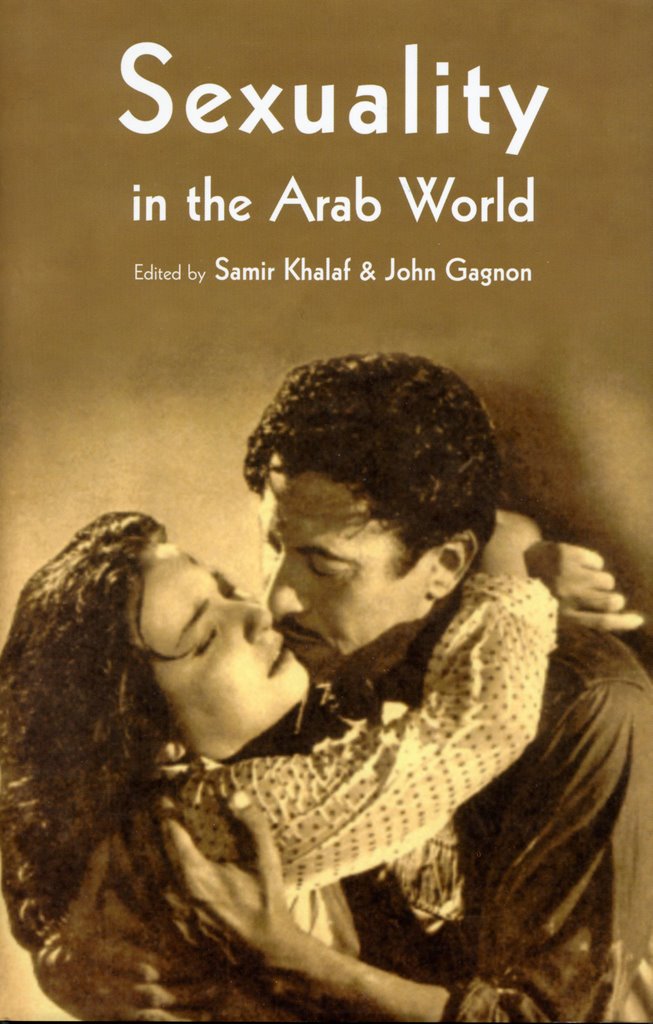
Hot from the stable of Saqi Books comes the new title 'Sexuality in the Arab World', complete with torrid cover. The publication of this book, hard on the heels of Briain Whitaker's 'Unspeakable Love: Gay and Lesbian Life in the Middle East', suggests that Saqi is carving a niche for itself in the vital but understudied (in the academic sense) area of Arab sexuality. The new book is edited by two prominent sociologists: Samir Khalaf, Professor of Sociology and Director of the Center for Behavioural Research at the American University of Beirut, and John Gagnon, Professor Emeritus of Sociology at the State University of New York at Stony Brook, who is described as 'a leading figure in the sexual research field.'

The book is a collection of papers which were presented at the three-day conference on Middle Eastern sexuality held in Beirut in December 2003. That conference was a follow-up to a conference held at St Antony's College, Oxford University, in June 2000 with funding from the Ford Foundation. Khalaf presents a strong case for an open and informed public debate on Arab sexuality. But despite the popular media, feminist groups, human rights advocates, medical and public health practitioners, NGOs and policy makers making repeated appeals to address the dire consequences of some of the problems around sexuality in the Arab world, little has been done to heed such calls. 'Sexuality remains a mystified, taboo and unexplored dimension of Arab culture,' Khalaf writes.

Professors Khalaf and Gagnon have each provided a valuable introduction to the book. In his introductory chapter 'Living with Dissonant Sexual Codes', Khalaf explores the ways in which in the Arab world 'the sexual realm, particularly in recent years, has been subjected to conflicting and dissonant expectations and hence has become a source of considerable uncertainty, ambivalence and collective anxiety.' Gagnon's chapter 'States, Cultures, Colonies and Globalization: A Story of Sex Research' put the study of sexuality in the Arab world in a global and historic context. Even in the US, where research into sexuality was pioneered, the field of sex policy especially in relation to HIV/AIDS is a politicla and religious minefield.

Susannah Tarbush

Tuesday, November 7, 2006

banipal translation prize

0 comments


(left: photo of Humphrey Davies by Samuel Shimon)

The art of translation from Arabic to English has taken a major step forward with the awarding for the first time of the Banipal Prize for Arabic Literary Translation. The £2,000 prize went to Humphrey Davies for his translation of Elias Khoury’s “Gate of the Sun.” The translation is published in the UK by Harvill Secker, and in the USA by Archipelago Press.

The new prize puts Arabic on a par with the five other languages which already had annual translation prizes of £2,000 each. All six prizes are administered by the Translators Association and the Society of Authors.

The prizes include the Scott Moncrieff Prize for translation from French, the Bernard Shaw Prize for translation from Swedish, and prizes for translations from German, Italian and Spanish. The awards ceremony for all the prizes took place at the British Centre for Literary translation, University of East Anglia.

The prize for translation from Arabic was established by Banipal, the magazine of modern Arab literature in English translation, and the Banipal Trust for Arab Literature, founded in 2004. It has been wholly sponsored during its first year by the arts patron and publisher Mohammed Al-Sowaidi of Abu Dhabi. The Banipal Trust’s honorary president Peter Clark said the first awarding of the prize was “a memorable event in the reception of contemporary Arabic literature in English.”

The award is Davies’ first prize for translation, although he received support for the translation from English PEN’s competitive Writers in Translation Program. He said the award “represents for me, primarily, recognition of the novel itself. ‘The Gate of the Sun’ is a work of extraordinary strength that non-Arabic readers need to have available.” He added: “I am doubly happy that, in translating it. I have helped to put before the reader of English so compelling an account of the dispossession of the Palestinians.”

Davies has a first-class degree in Arabic from Cambridge University, and also studied the language at the American University in Cairo. He completed his PhD at the University of California, Berkeley. For the AUC Press he has translated Naguib Mahfouz’s “Thebes at War”, Alaa Al-Aswany’s “The Yacoubian Building”, Ahmed Alaidy’s “Being Abbas el Abd” and Gamal al-Ghitani’s “Pyramid Texts”.

Literary journalist Maya Jaggi, one of the award’s three judges, said their choice of winner was unanimous. She added: “Inspired by refugees’ accounts of the Palestinian expulsion of 1948 and its lingering aftermath, Khoury’s ambitious and richly-crafted novel is an epic retelling of myriad individual stories through the central narrative of Khaleel, a doctor tending a comatose former Palestinian fighter in a refugee camp’s makeshift hospital on the outskirts of Beirut.”

The novel “subtly questions the nature of memory and history, literature and imagination, heroism and defeat.” It is “a momentous achievement, whose translation by Humphrey Davies brilliantly captures the nuances and style of the original.”

The other judges were the author Moris Farhi, and the scholar and literary translator
Roger Allen. Farhi commented: “What impressed me most was the natural poetry in the prose…Needless to say, to convey such delicate poetry to an English readership is also a great achievement by the translator.”

Susannah Tarbush Saudi Gazette, November 7 2006

the film 'iraq for sale'

0 comments
left: Edward Sanchez


The newly-released documentary film “Iraq for Sale: the War Profiteers” highlights the way in which a handful of well-connected US corporations have made a fortune from the Iraq war, to the detriment of both Iraqis and US nationals.

The well-researched documentary was shown at the Frontline Club in London last week. Made by Brave New Films, it is directed by Robert Greenwald. According to Rick Jacobs, the chair of Brave New Films, Iraq war profiteering has “alienated Iraqis, killed American soldiers and contractors and damaged American credibility more than the war itself.”

Greenwald examines how the Bush administration has offered no-bid unsupervised Iraq contracts to a small group of US corporations, earning them billions of dollars. He takes the viewer inside the lives of soldiers, truck drivers, widows, children and Iraqi torture victims who have been affected.

His film uncovers the connections between private corporations which have profited, and the decision makers who have allowed them to do so. Greenwald says that before he started working on the film, he was aware that corporations were making enormous profits from the war. “What I didn’t know was the amount of graft and corruption and cheating that was going on. And the big shocker was the fact that corporations, in doing what they do, cutting corners to increase profits, were resulting in people being killed. That was an eye opener to all of us.”

The incidents covered by the film include the killing and mutilation of four Blackwater contractors in Falluja in March 2004, for which the contractors’ families blame Blackwater. Private contractors played a role in the torture at Abu Ghraib prison. An Arab-American former translator for the Titan Corporation, Marwan Mawiri, witnessed “institutionalized waste, lack of employee supervision, incompetence and unethical management of employees.”

In April 2004 several KBR/Halliburton drivers were killed, and many others wounded, when they were sent by KBR into a volatile part of Baghdad. One driver, Edward Sanchez, says the massacre was “totally preventable. There was absolutely no reason for us to be there.” His colleague Bill Peterson says: “We were told repeatedly we were not soldiers, we were noncombatants, not to do anything that made us appear as soldiers or military personnel. And that we would not be sent into any areas of known danger.”

A former KBR water purification specialist, Ben Carter, says that from his first day in Iraq “I started to see just incredible waste and compromised safety standards.” A radio mechanic and former US soldier, David Mann, found that he and hundreds of other soldiers trained to provide logistical support were charged with training KRB contractors. “We shouldn’t have to train them how to do their job,” he says.

Rick Jacobs says he has worked with politicians and groups all over the US trying to promote the message of the film: “That we have to ask questions, to demand that Congress does its job. It appears that to do that, we need to make some serious changes in Washington. I hope and expect that the American public will look at this film and demand change.”

Susannah Tarbush, Saudi Gazette 10 October 2006
 
ban nha mat pho ha noi bán nhà mặt phố hà nội