Tuesday, March 28, 2006

banipal literary evening in london

0 comments

Hisham Mattar Posted by Picasa


Londoners wanting a taste of the literature being written by Arabs living in exile had their chance last Wednesday night when three London-based writers - Ghalya al-Said from Oman, the Libyan Hisham Matar and Ghalia Kabbani of Syria - presented their work at the Irish Centre in Hammersmith, West London.

They also had the chance to taste Arabic food from an enticing buffet of dishes such as ful, homous, kibbe and tabboule freshly prepared by the Iraqi novelist Samuel Shimon (author of "An Iraqi in Paris").

Shimon is co-founder of Banipal, the London-based magazine of modern Arab literature, which presented the evening. The event was part of the Westwords Live literature festival being held in West London by eight boroughs during March and April. It was introduced by Banipal's Publisher and Editor Margaret Obank, and chaired by Christina Phillips, an Arabic scholar who sometimes translates for Banipal.

Ghalya al-Said read in Arabic from her recently-published first novel "Days of Heaven". Obank, who read the English translation, described "Days of Heaven" as a novel that is set in London in the 1970s among the immigrant community. "The hero, Ghassan, is a fantasist Don Juan who left his homeland to come to try and find his fortune as a major con man and desperado, and all the adventures he has are recounted." Al-Said writes with acute observation and humour. Ghassan finds that London, unlike cities elsewhere, helps him to keep his many secrets.

Hisham Matar read from his first novel "In The Country of Men". The book trade regards this novel as one of the hottest books due to be published this summer. It was sold in auctions in Europe and the US within a week of being submitted to publishers. It will be published in July by Viking, an imprint of Penguin, and then in 13 other languages. A translation into Arabic is also under way.

Matar's sensuous, dreamy yet precise prose captures the atmosphere of Tripoli in the relentlessly scorching summer of 1979 as seen through the eyes of the nine-year old narrator. The sensitive boy's relationship with his troubled mother, and the mystery over his absent father glimpsed in the street, make a compelling start to the novel.

Christina Phillips read Ghalia Kabbani's story "A Cup of Tea With Mrs Robinson", translated into English by Ali Azeriah. The narrator of this thought-provoking story is a political refugee who describes returning home after a woman has assaulted her in the street injuring her face.

The husband's reaction to his wife's trauma falls far short of what she had hoped for. He is more concerned with discussing politics with his friends than with her welfare. With skill Kabbani takes us inside the realities of life for political refugees, and reveals the stresses political exile places on marriages. It is the English baby-sitter, formerly dismissed as a Mrs Thatcher type with her hairdo and her determination, who gives the narrator the spontaneous comfort she needs.

Susannah Tarbush
Saudi Gazette March 28 2006

Tuesday, March 21, 2006

from bangla-beat to afro-beat

0 comments

Idris Rahman

“From Bangla-Beat to Afro Beat” was the title of a concert held at the Queen Elizabeth Hall in London’s South bank Centre last Monday week to celebrate the musical heritage of Bangladesh. The concert was presented by Asia House, and the programme contained a message from the Bangladesh High Commissioner to the UK, Sabihuddin Ahmed, saying he hoped it would achieve its aim of “placing Bangladeshi music on the roster of mainstream performances in the UK.”

Runi Khan, who had the initial idea for the concert, said in her message in the programme that Bangladeshis, who comprise a significant portion of Britain’s Asian population, “are still best known for their curry houses and their rich musical heritage has had little sustainable exposure.” She hoped the concert would start to redress this situation.

The evening got off to an inspiring start with a pre-concert jazz recital, in the Queen Elizabeth Hall foyer, by the gifted jazz pianist Zoe Rahman and her clarinettist brother Idris who are of mixed Bangladeshi-English parentage. They gave wonderfully expressive and engaging performances in which they were accompanied by the lively Brazilian percussionist Anselmo Netto.

Award-winning Zoe’s second album, “Melting Pot” was released recently. Soothsayers, the band Idris leads, released its album “Tangled Roots” a few months ago. As a prelude to the “Bangla-Beat” concert, the recital included some Bengali material based on four songs by the singer and composer Hemant Mukherjee.

The “Bangla-Beat” concert was designed to cover a wide range of music, from traditional folk music and the music of the new generation in Bangladesh to collaborations between Bangladeshi, Asian and world musicians.

The first half of the concert featured Baul culture, declared last November by UNESCO as a national treasure. The Bauls are a mystical group of wandering faqirs who perform devotional songs accompanied by traditional string and percussive instruments.

The Baul performers were Abdur Rob Fakir and Shahjahan Munshi. Also on stage were members of the Ektaar All Stars. The young singer-songwriter Shayan Choudhury, known as Arnob, who is also an instrumentalist, composer, painter and music video maker, sang an appealing selection of songs. His debut solo album “Chaina Bhabish” was released last year.

The Ektaar line up also included Ektaar’s managing director Faisal Siddiqi (Bogey), as bass player and vocalist. He is the guitarist and vocalist of Renaissance, one of Bangladesh’s most established bands. On lead guitar was Al Fahmi Kazi Bashar, known as Kaartik, who plays lead guitar for the group Bangla. On vocals and percussion was Sahana Bajpaie, whose first solo album of songs by Tagore is due out soon.

The second half of the concert was given over to Bangladesh-born Kishon Khan, who grew up in London, and his new world fusion assembly of musicians called Lokkhi Terra. Khan played the piano and Rhodes electric piano. His line-up included more than a dozen performers, among them special guest Fazal Qureshi (second son of the late Ustadh Allarakha) on tabla, Pandit Dinesh on Indian percussion, and the young Pakistani flautist Haider Rahman. Other instruments included trombone, trumpet, cello, bass, guitar, drums and congas. Lokkhi Terra included two singers from Bangladesh, Armeen Musa and Aneire Khan.

Susannah Tarbush
Saudi Gazette March 21 2006
0 comments

Zoe Rahman in recital

Tuesday, March 14, 2006

British Council's Arabic translation seminar

0 comments
The four-day Arabic/English literature translation seminar organised in London last week by the British Council, in partnership with Arts Council England, was one of the most ambitious and wide-ranging explorations of the subject ever to have been held.

The seminar brought together leading Arab, British and other writers, translators, commissioning editors, literary agents, publishers and academics. The sessions on a variety of topics were supplemented by one-on-one interviews with two major Arab women writers, the Lebanese Hanan Al-Shaykh and the Moroccan Leila Abouzeid.

The seminar provided ample evidence of how rich and diverse the field of translating and publishing Arab writers has become in the past few years. One of the valuable spin-offs was the opportunity afforded for networking and contact building.

The event began on Tuesday at the London Book Fair, where a panel examined the translation of Arabic into English and vice versa, and the strengthening of links between the UK and Arab world in publishing, distribution, translation and cultural exchange.

The panel was chaired by translator, author and former British Council representative Peter Clark. It included Jordanian author Fadia Faqir, Palestinian poet and author Mourid Barghouti, Palestinian poet and novelist Ibrahim Nasrallah, and Margaret Obank, the publisher and editor of Banipal magazine of modern Arab literature.

On the following two days, the venue of the seminar was Goodenough College. There were several ‘guest hosts’ for specific sessions, among them Banipal, the British Centre for Literary Translation (of the University of East Anglia), the Poetry Translation Centre of London University’s School of Oriental and African Studies, and English PEN.

On Thursday evening there was a reception and dinner for seminar participants at the October Gallery in Bloomsbury, followed by author readings and a party. The final event was a brainstorming roundtable on Friday morning to discuss future plans and opportunities to increase links between UK literature professionals and Arab partners.

The Saudi novelist and short story writer Yousef Al-Mohaimeed, who is cultural editor of Al-Yamama magazine, was a speaker at a session on Thursday entitled: ‘How to create and maintain a dialogue: writers making connections.’ Born in Riyadh in 1964, Al-Mohaimeed is one of the new generation of Saudi fiction writers whose work tackles head-on the social conditions of the country.

Two chapters of Al-Mohaimeed’s novel “Traps of Scent”, translated by Anthony Calderbank, were published in Banipal’s special feature on the Saudi novel in its Summer 2004 issue.

“Traps of Scent” was originally published in Arabic by Riad El-Rayyes in Beirut in 2003; Al-Mohaimeed pointed out that because of censorship, a number of Saudi novelists have had their work published in Beirut. He expressed frustration at the misleading images of Saudi Arabia in the West, first as a country of camels, tents and oil and then, after 9/11, as a country of terrorism.

Al-Mohaimeed spoke of some of the difficulties facing Saudi novelists, and artists in such areas as film, theatre and the visual arts, but noted signs of an increased openness. He would clearly like British publishers to take an interest in Saudi novelists, but rejected pressure on those writers to write in a certain way. “In writing novels we feel that we are part of the world – we know the techniques of the novel and we want to contribute, but we don’t want to be ‘folkloric’.”
Susannah Tarbush
Saudi Gazette, 14 March 2006
Saudi novelist Yousef Al-Mohaimeed (L) and Syrian writer Fawaz Al-Haddad

Tuesday, February 21, 2006

Salma Khadra Jayyusi's Arabic fiction anthology

0 comments


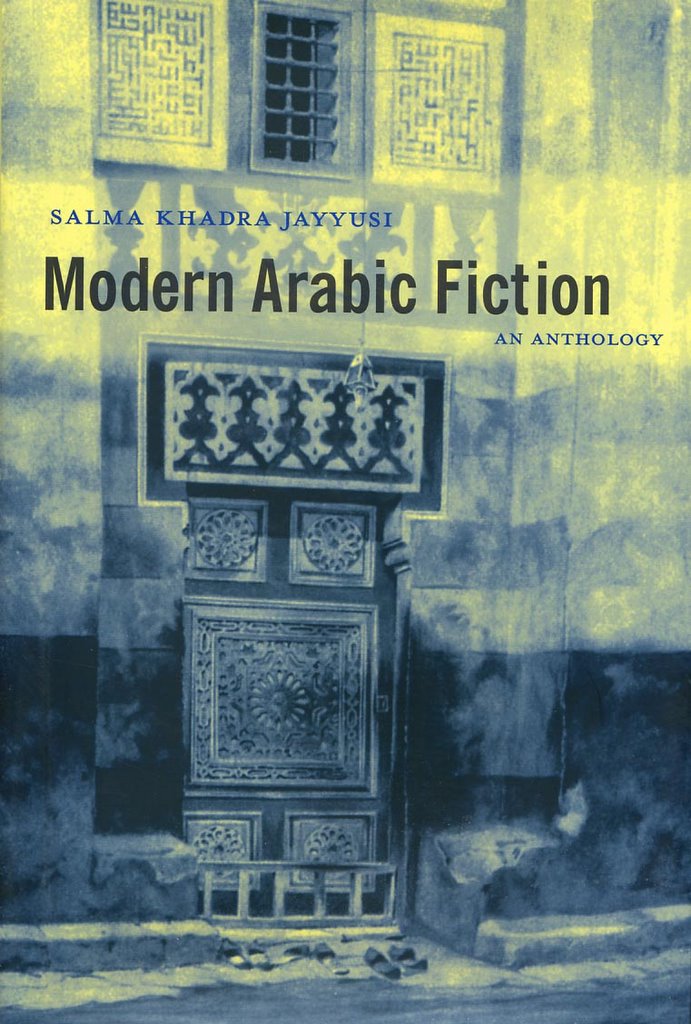
The renowned Palestinian scholar, poet and translator Salma Khadra Jayyusi has made a unique contribution to the study of Arab literature and civilisation during a long and productive career. The latest fruit of her passion for bringing Arabic literature to a wide readership is “Modern Arabic Fiction: An Anthology”, edited by Jayyusi and published by Columbia University Press. The anthology is a companion volume to “Modern Arabic Poetry: An Anthology” which she edited for the same publisher in 1987.

This ambitious fiction anthology has been many years in the making, and its 1056 pages encompass an immensely rich array of work by Arab novelists and short story writers translated into English. The short stories and novel extracts reveal the vitality and diversity of a literature that is still little known in the West.

The book is divided into three sections. The first includes the work of 14 “pioneers”. The second comprises short stories by 119 writers, and the final section groups extracts from novels by 28 writers (some writers appear in both these sections). There is a biography for each writer.

Jayyusi’s 70-page introduction is an essential guide to Arabic fiction. She traces the historical roots of fiction, with classical Arabic literature being “one of the richest and most varied in world literary history.” She points to Arabic influences on European literature, and to certain similarities between Arabic and Western fiction.

Jayyusi examines the development of the Arabic novel from the late 19th century and of short story writers from the 1920s. She points out that Egypt managed to stay at the centre of fiction in the Arab world, especially with the rise of Naguib Mahfouz in the 1950s. When Mahfouz won the Nobel Prize for Literature in 1988, this was “not simply a recognition of a single author’s achievement but also an acknowledgement of the fact that the Arabic novel had reached distinction on a global scale.”

Other writers whose work Jayyusi discusses at length in the introduction include novelists ‘Abd al-Rahman Munif, Ibrahim al-Koni, Gamal al-Ghitani, Ibrahim Nasrallah, Ghassan Kanafani, Edward al-Kharrat, Gha’ib Tu’ma Farman and Fu’ad al-Takarli, and short story writers Yusuf Idris and Zakaria Tamir. In compiling the anthology, Jayyusi has been keen not only to include such famous writers, but also the up-and-coming and the lesser known.

Almost all the translations have been undertaken afresh, even when previouisly published English translations of certain works exist. Most of the translations are collaborative efforts, pairing a translator from the Arabic with a writer. The translators include Jayyusi’s daughters May and Lena, Salwa Jabsheh, Aida A Bamia, Roger Allen and Mona N Mikhail. Among the distinguished writers with whom they have worked are Christopher Tingley, Anthony Thwaite, Jeremy Reed and Naomi Shihab Nye.

Jayyusi does identify one gap in Arabic fiction, when she writes that there is a need for a fiction to match the state of terror in which the Palestinians are living. She writes: “…neither literature nor art, as far as I know, has been able to match the colossal dimensions of this communal experience… a Palestinian Guernica is now overdue.”

Susannah Tarbush
Saudi Gazette, 21 February 2006

Monday, February 20, 2006

freemuse report on US music censorship

0 comments


The continuing row over the Danish cartoons has generated much debate over limits to the “freedom of expression”. Vivid proof of limitations to the freedom of expression in the musical arena came earlier this month when the Rolling Stones played the US Super Bowl halftime show.

The Rolling Stones’ performance was subjected to a form of censorship. When the group was singing lyrics deemed too suggestive, the microphones were temporarily silenced. In addition ABC, the broadcaster of the concert, imposed a five-second delay in transmission in case further censorship was needed.

Although the Stones later said that the censorship had been “absolutely ridiculous” and completely unnecessary, a National Football League spokesman stressed that the group had agreed to it.

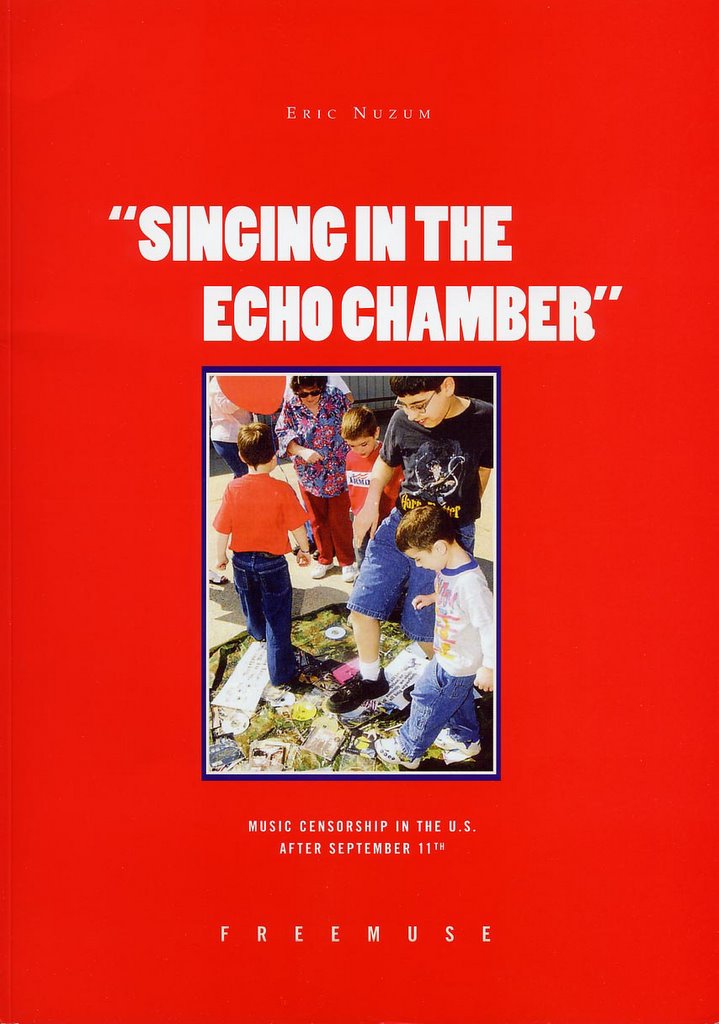
By chance, the censorship of music in the US since September 11 is the subject of a special report, “Singing in the Echo Chamber”, published a few days ago by the Copenhagen-based charity Freemuse which campaigns against music censorship

Freemuse says it is often assumed that violations of freedom of expression occur only in distant, undemocratic countries ruled by despots. “However, it has become obvious that any country undergoing war or stress introduces censorship as a tool to control its population and emerging discontent within the society.”

The picture on the cover of the 64-page report shows gleeful children trampling CDs underfoot. The report’s author, Eric Nuzum, sees the current censorship as part of the wider pattern of curbs on civil liberties in the US since September 11.

Nuzum highlights the role that much of the US media is playing in banning or condemning certain types of music, songs or actions of musicians. Citizens seem to support this, with four out of ten Americans considering that music should be censored.

The “echo chamber” in the report’s title refers to the media’s endless repetition of a news item without any sense of the checks and balances normally applied to reporting. In the post-September 11 climate, once an action has been labelled as “treasonous”, “unpatriotic”, “anti-Bush” or “unsupportive of troops”, these statements tend to become part of the echo.

Among the US music acts which have suffered reprisals from radio stations and other media and from the music-buying public because of their stance on US President George W Bush and the war in Iraq are the group Pearl Jam, the girl band Dixie Chicks and the singer Linda Ronstadt.

Although some eminent musicians have used their music to protest against Bush and the war in Iraq, the Freemuse report points out that some observers think this protest music is being stifled by the powerful corporations controlling the music industry.

There are also increasing curbs on suggestive material, particularly since the Super Bowl incident in 2004 when Janet Jackson’s breast was momentarily exposed by her famous “wardrobe malfunction.” This explains why the Rolling Stones found themselves censored.

Susannah Tarbush
Saudi Gazette 21 February 2006

Wednesday, February 8, 2006

naim attallah in touch with his roots

0 comments

In his first autobiographical book, “The Old Ladies of Nazareth”, the London-based publisher and entrepreneur Naim Attallah gave a delightful account of his boyhood in Palestine.

In his follow-up “The Boy in England” Attallah recounted his adventures after arriving in Britain to study engineering in 1949, an exile from Palestine. Attallah was avid for new experiences, and he was attractive to other people, particularly women, and had a knack for meeting the right person at the right time.

When the Israelis disrupted his father’s financial aid, Attallah took a series of unskilled jobs and was a fitter in an electrical components factory, a steeplejack, a hospital porter and a nightclub bouncer.

In his latest autobiographical volume, “In Touch With His Roots”, published like the previous two by Attallah’s publishing house Quartet, the story moves to the British and Arab business scenes of the 1960s. Attallah is now married to the lovely Polish girl Maria. As a Palestinian with British nationality, able to mingle freely in British and Arab society, urbane but with “a streak of devilment”, he is active as a banker at the interface of Arab and Western finance.

Attallah has an unusual approach to writing memoir, writing about himself in the third person. In the first two books he refers to himself as “the boy”; in the latest he has become “Naim”. He explains that this use of the third person helps him write without inhibition and unlocks memories that might otherwise not have resurfaced.

“In Touch With his Roots” is dominated by the late Palestinian-Lebanese banker Yusif Bedas and the Intra Bank that he founded. The book is dedicated to Bedas, for his “enterprising spirit and greatness of vision.” Yet Attallah does not shy away from discussing what he saw of some of Bedas’s weaknesses.

The collapse of Intra Bank in 1966 was one of the most dramatic financial-political shocks the Middle East has witnessed. As someone who had a sensitive position within the bank, and who was close to Bedas and his wife Wadad, Attallah is well placed to give an insider’s account of events which are still in dispute 40 years on.

There are lively descriptions of the characters Attallah encountered and who in many cases became friends. Among them are the Middle East Airlines (MEA) chairman Sheikh Najib Alamuddin, Egyptian businessman Ahmed Abboud Pasha (“the Pharaoh of Free Enterprise”), Hungarian aristocrat Vamos, King Hussein’s ex-wife Princess Dina, ballerina Dame Margot Fonteyn, and Lebanese actress Nidal al-Ashkar.

For Attallah, a most unhappy footnote to the Intra collapse came in 1995 when, without warning, Wadad Bedas and her three children issued a complaint with the juge d’instruction in Beirut against the Intra Investment Company, Attallah and Antoine Best. It alleged there had been a breach of trust with respect to the Bedas estate, allegations that Attallah describes as “preposterous”. In 2004 Attallah was informed that the court of 1st instance in Beirut had ruled in favour of him and the other defendants; no appeal against the ruling has been lodged.

After the collapse of Intra, Attallah pursued multiple careers in publishing, the arts and business, as will be told in the fourth part of the Naim Attallah story, to be published in early 2007.

Susannah Tarbush
Saudi Gazette 7 February 2006
 
ban nha mat pho ha noi bán nhà mặt phố hà nội