Tuesday, January 31, 2006

reem kelani's 'sprinting gazelle' CD

0 comments


When the Palestinian singer and music researcher Reem Kelani, on a visit from London, told women in the Palestinian refugee camp of Ein el-Hilweh in southern Lebanon her name they immediately burst into the traditional song “Sprinting Gazelle”. This was a tribute to the name Reem, which means gazelle (or more specifically, according to the Hans Wehr Arabic dictionary, white antelope or addax).

The spontaneous performance of the song by women of three generations epitomises the irrepressibility and deep-rootedness of Palestinian musical culture. The women also demonstrated for Kelani the circle dance that accompanies the song at weddings

Kelani has over the years done vital work in recording, arranging and singing the songs she has collected, as well as composing her own songs. The song she heard in Ein el-Hilweh is now the title track of her debut CD “Sprinting Gazelle: Palestinian Songs from the Motherland and Diaspora”, newly released on the British label Fuse Records. The infectiously danceable title track includes musician Tigran Aleksyan on the double-reeded yarghul that is played at Palestinian weddings.

The CD opens with Kelani’s haunting rendition of “As Nazarene Women Crossed the Meadow”, unaccompanied but for a background vocal drone. According to local Nazarene folklore, women would sing this song while saying goodbye to menfolk leaving to serve in the Ottoman Army.

In the CD’s sleeve notes, Kelani recalls how an elderly man from Shefa Amer near Nazareth approached her after a performance she gave in Dubai “and said that he had not heard this song for at least 60 years.”

Some of the ten tracks are based on traditional songs, such as “The Cameleer Tormented my Heart”, “Galilean Lullaby” and “A Baker’s Dozen”. Other tracks feature Kelani’s compositions for Palestinian poetry: “Mawwal – Variations on Loss” based on poetry by Mahmoud Darwish, “Yearning” by Rashid Husain, “Yafa!” by Mahmoud Asim al-Hout and “Qasidah of Return” by Dr Salma Khadra Jayyusi. The CD concludes with the rousing “Il-Hamdillah – Giving Praise”.

Running through the tracks is a sense of longing and pain, mingled with joyfulness and vibrancy. Kelani’s remarkable voice enters deep into the soul of the music with emotions ranging from tenderness to passion and fury.

Kelani is supported by a terrific lineup of musicians. Her core band, with which she often appears in performance, includes jazz pianist Zoe Rahman, whose piano improvisations (taqasim) add a magical dimension to tracks such as the evocative “Yafa!”

Woodwind whiz Idris Rahman plays clarinet, bass clarinet and tenor saxophone. On the percussion side, Iranian Fariborz Kiani plays daf, tombak and naghghareh, and Parick Illingworth plays drums. Oli Hayhurst is on double bass and Samy Bishai plays violin.

The sleeve notes are in the form of a 16-page booklet rich in information on each track and with the lyrics in both English and Arabic. The literary consultant is Palestinian scholar Dr Salma Khadra Jayussi and the poetry consultant the well-known British poet Alan Brownjohn. The cover and sleeve notes were designed by Nada Irani, and the Persian-style calligraphy was done by Iranian calligrapher and musician Bahman Panahi.

Reem Kelani is at:
http://www.reemkelani.com/

Susannah Tarbush
Saudi Gazette 31 January 2006

Monday, January 30, 2006

I see the stars at noon

0 comments
When there is news in the Western media about illegal migrantion from Morocco to Europe, it all too often takes the form of reports on the bodies of nameless would-be migrants being washed up on European beaches after their boat journeys end in disaster. The film “I See the Stars at Noon”, directed and co-produced by Saeed Taji Farouky, shows the picture from the other side by following the attempts of 26-year-old Abdelfattah from Meknes to reach Spain through “hijar sriyyah” (secret emigration).

Farouky was born in Britain in 1978 to mixed Egyptian and Palestinian parentage. His film’s title is a Moroccan saying which means that someone’s world is turned upside down.

Abdelfattah’s attempt to reach Spain fails when Spanish police board the ship that is transporting him and other illegal migrants. Last heard of, he was working as a security guard in neighbouring Tunisia.

The documentary was shown to acclaim at the Dubai Film Festival in December. I saw it last week at its European premier held at the Frontline Club in West London. Farouky and the film’s editor and co-producer Gareth Keogh fielded many questions afterwards. The two are co-founders of the production company Tourist with a Typewriter.

The film consists largely of dialogue between Abdelfattah and the unseen filmmaker as the young Moroccan tries to negotiate his way though the clandestine world of people-smugglers. Abdelfattah knows the risks but is willing to take them. His idea of life in Europe and of his prospects there are inflated.

Abdelfattah makes an appealing subject with his attractive looks, and his apparent decency and wish for a better life. He despairs of the future that awaits him if he remains in Morocco. In one scene he takes Farouky to where some of his friends are gathered, drinking and smoking kif, a collage of pictures of scantily-dressed women on the walls.

The unexpected development in the film is the way in which Abdelfattah turns the tables on the filmmaker, forcing him to examine the relationship between subject and director. He asks Farouky for help towards the 750 Euros he needs to pay the people smuggler for passage on a cargo ship, otherwise he will be forced to go on a risky “boat of death”. He points out that the filmmaker is benefiting from him: “Without me the documentary wouldn’t be possible.”

This absorbing and searching film reveals much about the dilemmas of being a documentary filmmaker, and about the desperate struggle many young Moroccans face and the factors that make them keen to reach Europe even at the risk of their lives.

Susannah Tarbush
31 January 2006

Tuesday, January 24, 2006

samira al-mana's novel in english

0 comments

Deeply Attached

The title of Iraqi writer Samira Al-Mana’s novel “The Umbilical Cord” reflects the deep attachment Iraqis in exile have to their mother country. Al-Mana has first-hand experience of the life of Iraqi exiles, having lived in Britain since 1965. She is married to another Iraqi writer, the poet and translator Salah Niazy, with whom she founded and produced the literary journal Alightrab al-Adabi (Literature of the Exiled).

“The Umbilical Cord” is one of five novels by Al-Mana, who has also written two collections of short stories. Her play “Only a Half” was read on stage in 1990 under the sponsorship of the International Women Playwrights’ Center and Buffalo State University, New York.

The Arabic original of “The Umbilical Cord” was published in 1990, and the English translation has now been published by Central Publishing Services of West Yorkshire, England. The translation was undertaken in conjunction with the late Charles M Lewis, to whose memory it is dedicated.

The novel takes the form of 14 interrelated stories revolving around two middle-aged Iraq exiles, divorced Afaf and diplomat’s widow Madeha, who is a fiction writer. Al-Mana depicts the society of Iraqi expatriates in London with skill and humour. She captures their suspicions and longings, and the corrosive effects of the appalling situation back in their homeland.

Characters recur in the stories. In the opening story “All That Jazz” Madeha encounters an acquaintance in an underground train. He shows her a teapot in the form of Prime Minister Margaret Thatcher and says: “That’s democracy, whatever they say! Mrs Thatcher sold in London’s department stores as a teapot! Her opponents laugh at her and take revenge.”

Madeha suspects he may be an informant, but when she gets off the train and remembers his old and torn collar is she convinced he is “one of the innocent” who had seen her by chance and wanted to share his grief and his loneliness. In a later story he asks Madeha why she had been suspicious of him.

In the title story, Afaf is assailed by memories of Iraq and its people while waiting on the platform of Gloucester Road tube station. On a visit from Iraq her uncle tells her tales of his dissolute past in Basra and the pain caused to his mother when his father took a second wife

When she looks at her sleeping uncle, Afaf thinks how he resembles many of the functionaries in Iraq and neighbouring countries. “They’re all cast in the same mould, fighting for party slogans, nationality, religion. How oppressed they are, and how much they have oppressed others, inflicting cruelty, and in turn suffered from cruelty.”

Afaf observes the ageing of her generation in the story “The Turquoise Ring”, in which a group of Iraqis who had studied in Moscow more than 20 years previously meets up at a party thrown by Madeha. After the 1958 revolution young Iraqis were very keen to study in Moscow, and Afaf met her husband Jalal there. Several stories in “The Umbilical Cord” describe how the marriage declines, alongside the disappointments of post-revolutionary Iraq.

Al-Mana’s satirical eye brings us memorable characters such as Munir Abu Seifen (“Shining Father of the Two Swords”) who is boss at an Arab publishing house and young female literary star Gazal Hamid around whom there has been much scandal and gossip.

The main flaw in “The Umbilical Cord” is not in its contents but in the typographical errors that mar the text. These will presumably be corrected in future editions.

Susannah Tarbush
Saudi Gazette 24 January 2006

Tuesday, January 17, 2006

toot is launched

0 comments
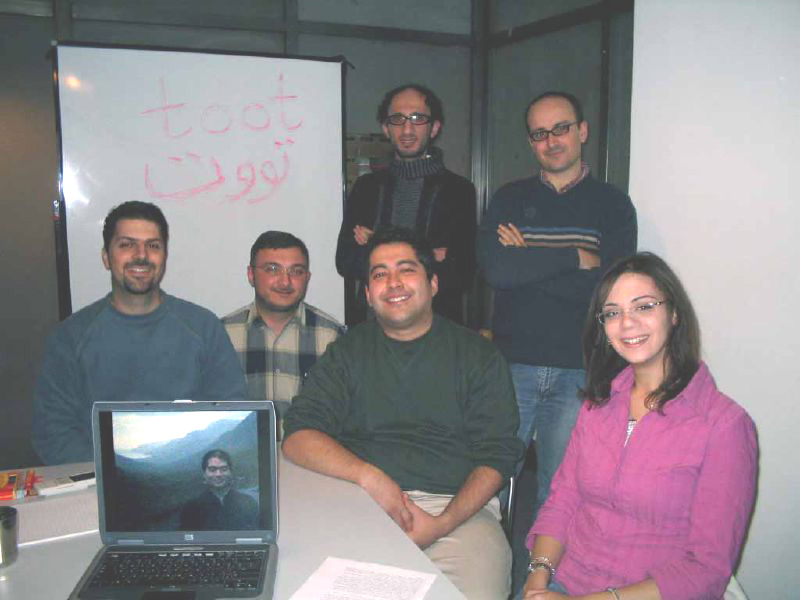
The toot team


The number of Arab blogs (online diaries) is mushrooming, and it can be a difficult and time-consuming task to try and pick one’s way through the thousands on offer to identify those with particular appeal.

“Toot”, a new website launched on 1 January, provides a way into the Arab blogosphere by presenting some of the best blogs around in an attractive and user-friendly way. The website points out that the word “toot” is both a fruit (it is Arabic for mulberry) that consists of little bits that make up a whole, and “the sound you make to draw attention to yourself.”

Toot’s Amman-based team constantly trawls through the toot list of the Arab blogs, whether in Arabic or English, and displays the most interesting posts and conversations. At present toot has a menu of 50 blogs, seven of them Saudi: blogger Ahmed’s “Saudi jeans” and “yawmeyat” blogs, “farah’s sowaleef”, “tech2click”, “al-mohareb”, “al doktoorah” and “prom 2000”.

Toot was founded by entrepreneur, blogger and podcaster Ahmad Humeid (co-owner of branding and web design firm SYNAX) together with his London-based friend Mazen Arafat, Mazen’s brother Karim, and George Akra.The other team members are chief designer Wael Attili, web developer Jad Madi and Roba Al-Assi, who manages the blogs.

Humeid told Saudi Gazette that he hopes to see more Saudi blogs added to toot as it expands, including technology-oriented blogs “that reflect the active open source community there.” He sees the Saudi internet as “a very interesting space, although dominated by the ‘discussion forum’ phenomenon - not to forget those ‘romantic’ sites.”

The toot-listed blogs include from one end of the Arab world “Moorish Girl”, the literary blog of Moroccan novelist Laila Lalami (currently living in Portland, Oregon), and from the other end “Muscatis”, written by Omani Osamah M Abdullatif and his wife. Blogs from many other Arab countries also feature.

The ‘what’s tooting’ section features nine handpicked bloggers of the day. The ‘tootreads’ section consists of posts that the team is currently reading, and ‘tootstream’ has the freshest harvest of posts, with blogs’ RSS feeds. The members of the toot team write a ‘toot(b)log’. Each month the site will feature the top 10 blogs, voted for by visitors.

Bloggers can submit their own blogs to toot for possible inclusion on the site. Humeid says that toot’s current set up will allow it to eventually handle 150-200 blogs.

I asked Humeid whether there is a risk toot will be seen as cliquey and elitist, especially by those whose blogs are rejected for inclusion. He said: “Although we do have our own understanding of what quality blogging is, if we manage to cover a wide spectrum of interests I don’t think we’ll be perceived as elitists. We will be on the constant lookout for fresh voices and we will rely on the pulse of the blogging community to determine what is good.”

He adds: “One thing we will be careful about is that we don’t want to include extremist or very distasteful content. That kind of stuff already has enough forms.”

Toot is at http://itoot.net

Susannah Tarbush
Saudi Gazette 17 January 2006

 
ban nha mat pho ha noi bán nhà mặt phố hà nội